Showing posts with label convey quality. Show all posts

Handcrafted Furniture Photography

Even though my studio is small, I'm occasionally called upon to photograph objects that are larger than my studio can comfortably accommodate. In these instances, I take my show on the road and take my studio equipment and background to their warehouse or factory and shoot there. This makes it easier for my clients because they have equipment and staff on hand to move things around if needed. It also saves them the expense of loading a truck, transporting to a studio, and having a couple of people away from the business for the day while they supervise a photo shoot. I shoot with my camera tethered to a laptop to the images can be studied and adjusted as their shot. The clients are able to give feedback on the spot, and the whole photoshoot moves much more quickly and efficiently.

Great photos of their furniture are essential not only for their websites but also for sending images to retail furniture stores so people can see that they can provide for customers.

The images below were recently shot in western Pennsylvania for a family owned furniture manufacturer. They make beautiful handcrafted furniture that is sold at craft fairs along the eastern seaboard. They contacted me because they were dissatisfied with the photographers in their region. They were all portrait and wedding photographers that lacked the knowledge, experience, and equipment needed to create images of their furniture that adequately captured their beauty.

photograph of furniture for a manufacturer
Click on the image to see it larger


photograph of furniture by a professional photographer
Click on the image to see it larger

professional furniture photography by Philadelphia photographer Richard Quindry
Click on the image to see it larger

furniture photography by Philadelphia photographer Rich Quindry
Click on the image to see it larger
professional furniture photographer
Click on the image to see it larger

professional furniture photography
Click on the image to see it larger

Furniture photography by professional photographer Richard Quindry
Click on the image to see it larger


Medical device photography


medical-products-photography
Click on the image to see it larger
More and more I'm called upon when clients have medical products that require very specialized skills and equipment to photograph. Medical devices are among the most notable of these. They are often tiny and difficult to accurately move into position. They require additional equipment to move them around in front of the camera. The images must be of the highest standard and communicate quality and precision. 

At these magnifications, optical laws make conventional photographic techniques ineffective. Entirely different approaches are needed to get passable results, much less outstanding ones. Some medical device photos require compositing up to 200 images taken at different focus points to create one image that shows sharpness throughout the entire product. I must say though, that I love the challenge of capturing beautiful medical device images. Here are a few examples of medical products and devices. I've added insets in some of the medical device photos to show how tiny they are.

You can see more examples of my medical device photography at my site that show additional examples of my work in this specialty: MedicalDevicePhotography.com


photo of medical device showing it's relative size
Click on the image to see it larger


The Intention of the Photographer

Click on the image to see it larger

Click on the image to see it larger

Click on the image to see it larger
In my opinion, when evaluating the work of photographers to decide who to hire, it's important to try to discern the intention of the photographer.

Now yes, technical aspects of the images are also essential. Photographs are only as good as the weakest link that created them. (Unless the photographer got lucky).

This includes the quality and consistency of the lighting in addition to the quality of the cameras and lenses. It also consists of the skills of the photographer: technical knowledge, mastery of light, attention to detail, compositional skills, problem solving abilities, creativity, their expertise and artistic ability with Photoshop and other post-production programs; and the interpersonal skills that are so necessary to evoke the desired expressions and body language when people are photographed.

Assuming the photographer has all of this down, there is still another problem. Many photographers see themselves as artists and try to create images that will draw attention to themselves so everyone will be impressed at how great they are. It's like a writer who wants to write the great American novel that will impress everyone with his or her writing skills. What makes a writer great though, is when the reader gets so involved with the story that they are unaware of the writing. It's the same way with photography.

When someone engages my services for a project, unless specifically instructed otherwise, I intend to create images that will improve their image and increase their sales.

It's not my goal for people to say "that's a great photo." My goal is for the viewer to see a product and feel it's beautifully made and desirable to buy. For the viewer of a room to think, what a beautiful space. For the viewer of a person to think: they look attractive, professional, intelligent, and trustworthy. I trust them enough to do business with them.

Without a doubt, the intention of the photographer matters. Remember, it's only creative if it sells.

Indeed, we "buy with our eyes." 


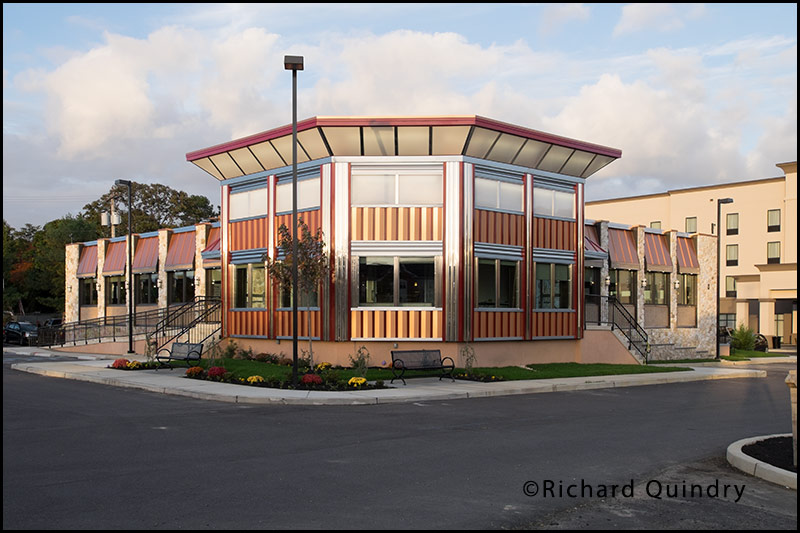
Photography of a Diner

Finished image

Primary Source Image - (Click on the images to make them larger.)


I was recently commissioned to shoot this restored diner for use in their ads and on their website. They requested a sunset shot which meant that the sunlight on the diner would also light up the hotel immediately behind it, causing them to blend together in a photograph. This caused a major visual problem that could only be solved during post-production. The job had to be done quickly as it was to have it's grand opening in 10 days and the trees were about to lose their leaves. After 5 days of rain we had our chance.

Two images were blended together with additional Photoshop work to create the final image. The primary image was a shot of the building at sunset as requested. The other image was taken about a half hour later after dark to record the lights inside the diner.

Some of the additional Photoshop work was darkening down the hotel, repaving the parking lot, removing the telephone pole and wires, removing the truck, the post on the right side and the light pole on the right which was forming a tangent with the edge of the diner. Anything that was not part of the main subject was removed or subdued in order to simplify the image as much as possible and to direct the viewer's attention to the diner.

Great photos are usually not taken; they're made. 

I'm usually more subtle in my color palette but the building is pretty unconventional looking and I decided to play it up and give it a bit of a painterly quality. It's always fun transforming the ordinary into something extraordinary.

See more examples of my work as a Philadelphia architectural photographer.

See more examples of my work as a Photoshop expert. 

The Perception of Quality

Product photography by Richard Quindry


Click on the image to see it larger


This image was created last week for a client that manufactures high-end skincare products. It's for a business to business ad that offers a special promotion price for this group of products to the dermatologists, plastic surgeons and medical spas that sell them. 

This marks the 50th time that they've called on me to do their photography. I photographed, enhanced, retouched and delivered this and two other images less than 4 hours after their delivery to the studio. 

Think of the internet as a dating site

The internet is a giant match.com, and your website is your "listing". You're competing with other businesses to attract people who are deciding who to "ask out" (someone they'd like to do business with). They're searching, and they're comparing you to others. They have MANY to choose from.

If you were on a dating site what would be the first thing you'd look for?

If you're like most people, you'd check out their photos. What if they didn't have a photo? Would you think they had something to hide?

What if you saw a photo of Angelina Jolie or George Clooney on someone's listing? What would you think then? Could you trust them? That's what happens when the photos used aren't theirs. They're called stock photos.

Most people compare the photos, then if they like what they see they read to find out more.

If you want your website to attract new business, great images are vitally important. It's foolish to skimp on photography because we buy with our eyes. Your website is being compared to others. Lots of others.

You need images that attract, create desire and inspire trust. If you don't have them, they won't even read about what you have to offer. They'll just leave your site and go elsewhere.

Painful, isn't it?

Recent assignment for a jewelry ad

Jewelry Ad photographed by Philadelphia Jewelry Photographer Richard Quindry
Click on the image to see it larger.

This image was created for a full page ad for jewelry from Alaska. It will appear in magazines on Alaskan cruise ships in addition to posters.

The jewelry is intentionally the sharpest part of the image so that the viewer's attention is drawn to it. Everything else plays a supporting role to frame and draw attention to the jewelry. 

The cuffs of the coat form the top of a heart.

Some more examples of my jewelry photography.

It's not enough to just have images that get attention.

Many who don't know better often think "All I need is a photo that will get attention", figuring that a viewer will then read the copy. It's not that simple.

In the case of an advertisement you do need an image that will stop viewers from flipping past your ad, but it's still not enough. Attention is really very easy to get. An image of a train wreck or a dead cat will get attention, but it most certainly won't make people want to buy. The image also needs to increase desire for the product or service that you're selling.

If your talking about images for a website, attention doesn't even enter into it. If they're at your website already you don't need to get their attention, you've already got that. They're there for information. You need well executed, beautiful and interesting images that communicate benefits to the viewer. You're selling trust, and images such as these go a long way to providing the information and trust that they require before they'll buy.

How to convey quality

Here's a link to an excellent article in Entrepreneur magazine by John Williams - "6 Ways to Convey Quality". He has some very good advice. (Although I'm in total disagreement with him about the use of stock photography. Stock photos and communicating quality don't go together, no matter how good the photos look - they don't ring true.). Check it out.

Learn from Apple

Apple has some of the best marketing and branding (and products) on the planet. Learn from them, study their website - www.apple.com.

They understand that people buy based on their emotions and then look for logical reasons to justify their purchases. They get people to pay a premium for their products (premiums which I happily pay myself). Look how they use images to communicate their message.

They use beautiful images and almost always combine them with a caption or headline. (They understand that people are busy and that photos communicate much faster than words.) People also read captions on photos much more than body copy.

They use large photos on each page. Photos that make their products look great.

They have more photos and less words - only increasing the amount text as the viewer is drawn into learning the details about the products benefits and features.

They never, never, never use stock photos.

Almost every selling point is reduced to a few lines or a paragraph and has an accompanying photo or illustration. They say less and show more.

They communicate beauty and simplicity with everything that they do. Their products, their marketing, their packaging, their instructions, and their software. All of these things strengthen their brand, increase their sales, allow them to have higher profit margins, and improve their customer's experience and satisfaction.

They get it.

Shooting clear objects


(click on the image to see it larger)

This image is one of several that I did the other day for a very well known brand of acrylic plastics. It's for a marketing piece targeting companies that manufacture single use medical products, and is meant to show a both a wide range of types of products and an ability to produce very complex devices. When marketing to high end buyers such as are in the medical industry, it's really important to have images that convey quality.

Clear, shiny objects are especially difficult to shoot and even more difficult to make look good. The concept of the shoot and the art direction was done by Barbara Craig, who always manages to come up with an interesting approach - it was her idea to have them floating in space.

All I had to do was throw them up in the air and shoot quickly. :)

Photos that communicate quality


(click on the image to see it larger)

This image of a '67 Corvette Stingray die-cast model was created for The Franklin Mint along with some detail shots. It was quite cool actually. The lights worked, the windows cranked up and down, and much more. They need photos that communicate quality, create desire and make their models look as realistic as possible. Remember, we buy with our eyes. High quality photos can make all of the difference between making a sale or not. Great marketers like The Franklin Mint get it. They understand the vital role that photography plays in motivating buyers to purchase.

Shoot for an interior designer.


(click on an image to see it larger)

Just shot these for Dana Neeld, a very talented interior designer in the Philadelphia region. These were shot in a 60 year old home that she did an amazing transformation on. They'll be used in her portfolio and on her website.

These images, especially when combined with the "before" images will be invaluable in her marketing when it come to showing potential clients what she brings to the table.

We buy with our eyes.


(click on an image to see it larger)

These are a few of the images that were shot two days ago for an interior designer. We were tight for time and budget, so I shot mostly available light, averaging about 15 minutes setting up and shooting each image.

The images don't come out of he camera looking like this. Extensive post-production is required to make the most of the data captured by the camera. The post-production on this assignment averaged about 30 minutes each image.

I show these to illustrate that a good interior images are often possible without going in with a crew and doing extensive lighting.

These images will be used on the designers website and in her portfolio. Since people buy with their eyes, photographs are by far the most effective way to show what she can do.

Remember, if you provide a service, you're selling trust. You can't show a buyer in advance what you're going to deliver, but you can show what you've done for others. Perception is everything, and you can't afford to fool around with images that are less than the best that you can afford. If you miss out on getting a new client because your photos don't do justice to your work what have you saved? Great images aren't an expense, they're an investment.

Clean room operation


(click on the image to see it larger)

One aspect of my work that I find very enjoyable is being able to go into all different kinds of manufacturing environments and seeing how things are produced.

I recently shot this (and many other related images) at a New England pharmaceutical plant. It shows my client's product (syringes) being filled by machinery in a clean room. 

It's not creative unless it increases sales.


(click on the image to see it larger)

The purpose of your images should always be to increase sales. They should be eye-catching, convey quality and create desire. 

Unfortunately, many professional photographers, graphic designers, creative directors and ad agencies just don't get it. They get so caught up in their desire to "be creative", win an award or copy the latest fad that they totally miss the point. They forget that the whole reason they're hired is to increase sales.

In the right light (and with some help in post-production), everything is beautiful.

The six images above are from a series of about 40 that I just shot for a housewares manufacturer. They've been digitally enhanced and retouched as the prototypes provided were scratched up and didn't match the colors desired for the final products.  The colors were modified in post-production to match the PMS colors specified. 

The photos you use create powerful perceptions of your products or service. High quality professional photos provide a great return on your investment through increased sales.

Images that aren't high quality create the perception of an inferior company and inferior products. The money you think you're saving is small compared to the sales you'll lose.

Images that increase sales will return profits that far exceed their modest cost. Cheap shots  will lose you sales without you even knowing it.

Could your competitors use the same images you're using?

Are you using generic images that your competitors could use? If so, you're making a BIG mistake. 

Think of it this way. . . would you use copy that would work equally well for your competitors? Copy that if they just changed the name of the company or product would work for them as well as you? 

If you use copy that makes you look just like everybody else, you're giving the reader no compelling reason to buy from you (unless you're the cheapest). You're communicating no clear benefit over your competitors. It's the same with your photos. Stock photos don't cut it.

Use professional photos of your staff, facilities, products, processes and happy customers to build trust, convey quality and create desire. Choose images that strategically communicate the benefits that you or your products provide. Don't choose images just to make your website or brochure pretty. Use images to influence how buyers see you. 

Perception is everything.

How good do your photos need to be?

There's a lot of insight into business and marketing that I learned from a joke: 

Two campers in a field out west see a grizzly bear charging them from a distance. One camper starts putting on his sneakers. The other says "You'll never be able to outrun that bear." He replies: "I don't have to - I just have to outrun you!"

Your website, your brochures, your photos and your copy don't have to be the best in the world, but they DO need to be at least as good if not better than your major competitors if you don't want to be "eaten by the bear" of the recession. 

You have competitors. While you shouldn't wish them badly, you have a responsibility to stay in business for the benefit of your clients if you offer a superior product or service. You do this by effective marketing.

Buyers will compare your website and brochures with your competitors. What image do they project? How well do they present your service or products? Do they make you look like everybody else in your industry? Do they convey quality? Do they build trust?

Remember though, you must deliver what your marketing promises. If you don't, the negative word of mouth that's spread will hurt your business more than your marketing helped it.

Transforming the ordinary


Too often, companies think that what they have to photograph is too ordinary and not worth shooting. With the right viewpoint and the right light, nothing is ordinary - everything is extraordinary.

 This image was created for a business to business ad for a manufacturer and distributer of party supplies. 

Great photos can transform the ordinary into the extraordinary.  They capture attention, convey quality, build trust and create desire. And they're memorable. 

Don't think for a second that you'll save money by doing it yourself or hiring whoever is the cheapest.  If the images are part of your efforts to gain new customers it's false economy to go cheap. Shoot cheap and you'll look like a third rate operation. Don't believe me? Buy a balloon; photograph it; compare. If your image falls short, then anything else you shoot would fall short of how it could look too.

Perception is everything. Cheap photos won't attract new customers. The money you'll save that day pales in comparison with the income you'll lose by failing to attract new customers. Great photos aren't an expense, they're an investment. 

You only have one chance to make a good first impression

For most people the web has replaced the Yellow Pages as the place to find products and services. If the purchase is large or important to them they'll often cruise several sites before deciding where to take their business.

They'll compare websites and the information provided on them to see who they're most comfortable doing business with. They'll get their first impression of your business from your website and first impressions are lasting.

How does your site compare? Does it show what makes you different from your competitors and how these differences benefit the customer? Does it make you look professional? Does it build trust? Does it enhance your image? 

Using professional photos of your key people and facilities goes a long way toward building trust and attracting those customers that you're best suited to serve. Done properly, they'll do much to enhance your image. 

Your site and the images on them control how you're perceived by potential customers. You don't need the best website in the world, you just need one that's a little better than your competitors. One that conveys meaningful information and builds trust.

Fortunately, this is not difficult as many of your competitors probably use stock photos. Images that don't provide meaningful information and that make them look just like everybody else.