Showing posts with label architectural photography. Show all posts

The Intention of the Photographer

Click on the image to see it larger

Click on the image to see it larger

Click on the image to see it larger
In my opinion, when evaluating the work of photographers to decide who to hire, it's important to try to discern the intention of the photographer.

Now yes, technical aspects of the images are also essential. Photographs are only as good as the weakest link that created them. (Unless the photographer got lucky).

This includes the quality and consistency of the lighting in addition to the quality of the cameras and lenses. It also consists of the skills of the photographer: technical knowledge, mastery of light, attention to detail, compositional skills, problem solving abilities, creativity, their expertise and artistic ability with Photoshop and other post-production programs; and the interpersonal skills that are so necessary to evoke the desired expressions and body language when people are photographed.

Assuming the photographer has all of this down, there is still another problem. Many photographers see themselves as artists and try to create images that will draw attention to themselves so everyone will be impressed at how great they are. It's like a writer who wants to write the great American novel that will impress everyone with his or her writing skills. What makes a writer great though, is when the reader gets so involved with the story that they are unaware of the writing. It's the same way with photography.

When someone engages my services for a project, unless specifically instructed otherwise, I intend to create images that will improve their image and increase their sales.

It's not my goal for people to say "that's a great photo." My goal is for the viewer to see a product and feel it's beautifully made and desirable to buy. For the viewer of a room to think, what a beautiful space. For the viewer of a person to think: they look attractive, professional, intelligent, and trustworthy. I trust them enough to do business with them.

Without a doubt, the intention of the photographer matters. Remember, it's only creative if it sells.

Indeed, we "buy with our eyes." 


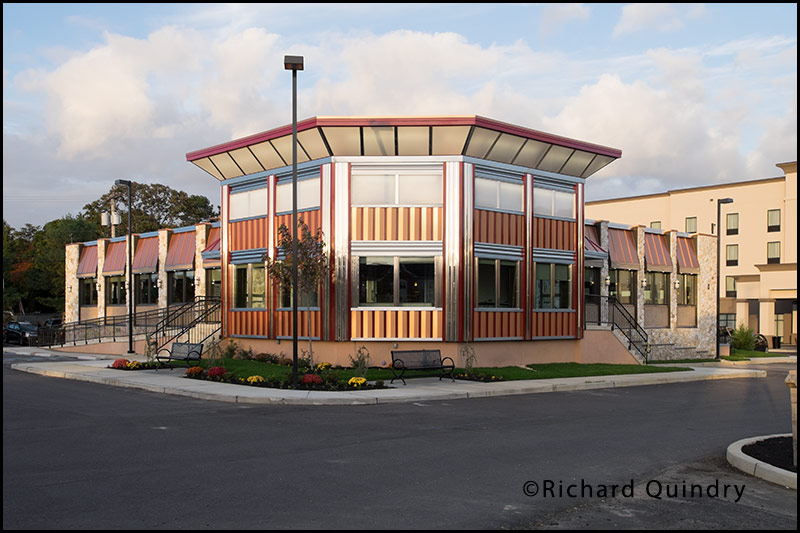
Photography of a Diner

Finished image

Primary Source Image - (Click on the images to make them larger.)


I was recently commissioned to shoot this restored diner for use in their ads and on their website. They requested a sunset shot which meant that the sunlight on the diner would also light up the hotel immediately behind it, causing them to blend together in a photograph. This caused a major visual problem that could only be solved during post-production. The job had to be done quickly as it was to have it's grand opening in 10 days and the trees were about to lose their leaves. After 5 days of rain we had our chance.

Two images were blended together with additional Photoshop work to create the final image. The primary image was a shot of the building at sunset as requested. The other image was taken about a half hour later after dark to record the lights inside the diner.

Some of the additional Photoshop work was darkening down the hotel, repaving the parking lot, removing the telephone pole and wires, removing the truck, the post on the right side and the light pole on the right which was forming a tangent with the edge of the diner. Anything that was not part of the main subject was removed or subdued in order to simplify the image as much as possible and to direct the viewer's attention to the diner.

Great photos are usually not taken; they're made. 

I'm usually more subtle in my color palette but the building is pretty unconventional looking and I decided to play it up and give it a bit of a painterly quality. It's always fun transforming the ordinary into something extraordinary.

See more examples of my work as a Philadelphia architectural photographer.

See more examples of my work as a Photoshop expert. 

Photography for an Interior Designer

(click on an image to see it larger)

This is a sampling from 15 interiors that I photographed the other day for Dana Neeld of Staging Spaces, an exceptionally talented interior designer in the Philadelphia region. We were tight for time, so I shot with minimal lighting, averaging about 15 minutes to set up the equipment and shoot each view. I prefer this approach because the photos "feel more real" to me.

The images don't come out of the camera looking anything like this. Cameras don't render scenes the way we perceive them. Extensive post-production is required to make the most of the data captured by the camera and create an image that has depth and looks real. Up to a dozen, images are combined to create each image. The post-production time averaged about 45 minutes for each image.

I show these to illustrate that excellent interior images are possible without going in with a crew and doing extensive lighting.

These images, especially when combined with her "before" photos are invaluable for her marketing as they show potential clients what she brings to the table. Since we buy with our eyes, photographs are by far the most effective way to demonstrate what she does.

Remember, if you're providing a service, you're selling trust. You can't show a buyer in advance what you're going to deliver, but you can show what you've done for others. Perception is everything, so you can't afford to use images that are less than the best.  

Great images aren't an expense, they're an investment.


Shoot for an interior designer.


(click on an image to see it larger)

Just shot these for Dana Neeld, a very talented interior designer in the Philadelphia region. These were shot in a 60 year old home that she did an amazing transformation on. They'll be used in her portfolio and on her website.

These images, especially when combined with the "before" images will be invaluable in her marketing when it come to showing potential clients what she brings to the table.

We buy with our eyes.


(click on an image to see it larger)

These are a few of the images that were shot two days ago for an interior designer. We were tight for time and budget, so I shot mostly available light, averaging about 15 minutes setting up and shooting each image.

The images don't come out of he camera looking like this. Extensive post-production is required to make the most of the data captured by the camera. The post-production on this assignment averaged about 30 minutes each image.

I show these to illustrate that a good interior images are often possible without going in with a crew and doing extensive lighting.

These images will be used on the designers website and in her portfolio. Since people buy with their eyes, photographs are by far the most effective way to show what she can do.

Remember, if you provide a service, you're selling trust. You can't show a buyer in advance what you're going to deliver, but you can show what you've done for others. Perception is everything, and you can't afford to fool around with images that are less than the best that you can afford. If you miss out on getting a new client because your photos don't do justice to your work what have you saved? Great images aren't an expense, they're an investment.

Photography of interiors


(click on the image to see it larger)


before lighting and enhancement

You can compare the images more easily here.

Interior decorators have a problem. To get new work they need to show potential clients what they've done, but driving them around to past jobs isn't desirable or practical. Their own photos will fail to impress. They need images that are inviting and can capture a buyers imagination.

This interior is from my most recent shoot for a Philadelphia based interior decorator. She uses my images on her website, for direct mail and in her portfolio.

She does beautiful work, but capturing interiors well is always a challenge. They're extremely contrasty, especially during the day, and snapshots won't record them properly. This one was especially challenging because of the combination of the bright window and the black piano.

In addition to the specialized equipment required; viewpoint, staging, lighting and digital enhancement in post-production are all crucial components of high quality interior photography.

When choosing a photographer to do interiors, make sure that you use a photographer with a lot of experience doing architectural photography. Their photos will increase your sales and can pay for themselves very quickly.

In the end, the best pictures always win. It's only a question of who has them.

Creating an iconic image


Enhanced (click on the image to see it larger)


Before (click on the image to see it larger)

This image was just created for Cooper University Hospital in Camden, NJ. I was contacted by the marketing director because they wanted a photo of their new $220 million dollar patient care pavilion for a PR release inviting the media to their grand opening. The only problem was that the outside of the building was not finished.

They didn't have the budget for me to scout the facility in person so that part was done by looking at snapshots that were sent to me and by surveying satellite images of the site. Because there was no landscaping and the ground was filled with construction equipment and workers I decided to shoot up on it and eliminate ground level. This would also make it look heroic and more important.

After determining what approach that I was going to take, the sun positions were calculated for the day of the shoot. I wanted the brightest reflections to be near the Cooper sign, and figured 1-3 pm was my window of opportunity. This was shot just after 2pm.

When I'm shooting an image like this, my primary thought is that of capturing information. I know that I'm going to be working on the image to give it more drama. When an attempt is made to do that in camera, there's a huge risk of losing highlight or shadow detail that can never be recovered.

The canopy and fascia on the front of the building (the sign is on the side of the building) had to be constructed in Photoshop be me using the architect's rendering as a guide. There were also many wires coming down from hoists on the roof. These were also reflected in windows and casting shadows. The retouching and enhancing took me about 8 hours to complete.

They now have an iconic image that they'll be able to use for years.

You can see more architectural images in my architectural photography portfolio.

Philadelphia photographer Rich Quindry welcomes you.


Hi, I'm Rich Quindry, a Philadelphia photographer and Photoshop expert. I help companies increase their sales by crafting digitally enhanced images that create desire, convey quality and build trust. I do this by combining my skills as both an advertising photographer and a Photoshop expert. I have several multinational clients.

I'm hoping to start a conversation on effective marketing and branding, with an emphasis on using images to influence buyers perceptions and attitudes. I've been doing photography for advertising and marketing a long time and have seen many changes in this industry - not always in ways that improve sales. 

This blog will be a place where I post recent projects and discuss the purpose of the images. It is my intent to also share ideas relating to photography, advertising, Photoshop, branding and marketing. Most of these ideas do not originate with me, but rather from the hundreds of authors that I've had as my mentors by way of reading their books. 

Whenever I can remember the original source of an idea, I'll attempt to give appropriate credit. I've learned a lot from these mentors, but by no means will I ever consider my knowledge complete - it's all work in progess. I hope that these posts are helpful to anyone wanting to improve their effectiveness in these areas. I welcome your comments. 

All images on this site are copyrighted by Rich Quindry and may not be used without permission.